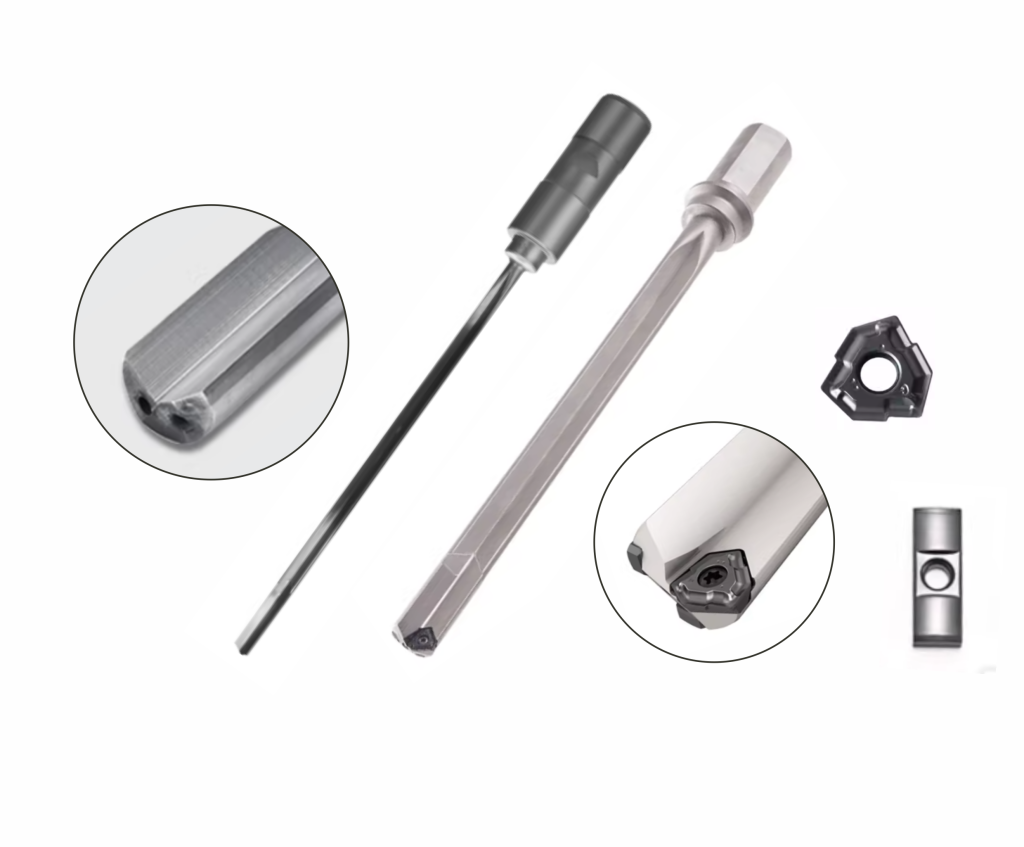
1,Chipping and edge fracture
- Occurs during initial machining
- Check if the guide bushing and gun drill fit smoothly, and if the end face aligns perfectly with the workpiece.
- Verify the bushing support is properly adjusted (neither too loose nor too tight).
- Confirm the machine tool feed settings are correct to avoid minor collisions.
- Inspect workpiece clamping for any looseness.
- Occurs during normal machining
- Check if the gun drill is worn and requires regrinding.
- Review machining parameters to ensure the cutting rate is appropriate and consistent.
- Verify chip evacuation is smooth at deeper drilling depths.
- Check for material impurities or inconsistent hardness.
- Occurs during hole breakthrough or retraction
- Ensure feed rate is reduced during these stages.
- Check for poor straightness or hole shrinkage, which increases friction during retraction.
- Avoid excessive speed that may catch on the guide bushing chamfer.
2,Short Tool Life
- Rapid Wear
- Assess the stability of the machine tool’s operating conditions.
- Verify feed parameters match the recommended specifications (see parameter table).
- Check the condition of guide bushings, plastic bushings, and bearings (plastic bushings must not be loose).
- Ensure the correct gun drill length, angle, and guide strips are selected for the application.
- Confirm the cutting oil type, temperature control, filtration, and oil pressure match the gun drill specifications.
- Evaluate the workpiece material’s properties, uniformity, and hardness consistency.
- Tool Burning
(Follows the same troubleshooting points as Rapid Wear)
3,Machining Accuracy Issues
- Poor Surface Finish
- Adjust parameters (typically, reduce spindle speed and increase feed rate).
- Check for spindle or gun drill vibration (inspect spindle, bushings, and gun drill).
- Ensure both the workpiece and gun drill are securely clamped.
- Select the appropriate guide strips and angle.
- Use cutting fluid with the correct concentration and adjust oil pressure.
- Poor Straightness
- Verify machine tool stability and compatibility of guide and plastic bushings.
- Select optimal machining parameters.
- Choose the correct guide strips and angle.
- Check if the workpiece has thin walls or asymmetric geometry.
- Poor Roundness
(Follows the same troubleshooting points as Poor Straightness)
- Hole Diameter Deviation
(Follows the same troubleshooting points as Poor Straightness)
4,Chip Management
- Unbroken Chips
- Increase oil pressure if it is insufficient.
- Reduce excessive or improper cutting rates.
- For special materials, select the appropriate tool angle and chipbreaker design.
- Inspect the gun drill’s outer corner for wear.
- Check for nicks on the gun drill’s end face or cutting edge.
- For stringy chips, increase oil pressure and reduce feed rate.
- Chip Clogging & Tangling
(Follows the same troubleshooting points as Unbroken Chips)